15 Magical Places to Visit in Southwest France (That Aren’t Bordeaux)
When it comes to traveling in France, the vast majority of people generally stick to Paris and the surrounding area. Some visitors will branch out to other spots like Normandy or the French Riviera, or maybe take day trips to Champagne or the Loire Valley. Fewer will venture further afield, perhaps to Provence for lavender or Bordeaux for wine.
And this isn't a bad thing; Paris is magical, after all, and I'd never tell you to skip it! But if you're looking to explore an area of France that you haven't already seen a million times on Instagram, then let me introduce you to the southwest of France.
Now, the southwestern part of France is by no means “undiscovered”; Bordeaux is one of the most-visited cities after Paris, and many of the smaller towns in the Dordogne do indeed get plenty of European visitors during the summer months. BUT, this part of France is still fairly under-the-radar when you compare it to all the other popular parts.


15 magical spots in Southwest France
I absolutely LOVED exploring this bucolic part of France on a road trip with my friend Kat. We skipped the biggest cities (no Bordeaux for us, and only a brief stop in Toulouse), and focused instead on magical medieval towns, prehistoric caves, charming castles, and the rivers and landscapes of southwest France.
We visited in mid-April, which was the absolute perfect time to be here. The little towns were mostly quiet, the wisteria was blooming, and the weather was absolutely perfect for exploring.

Here’s a look at 15 of the best destinations that the southwest of France has to offer (not counting Bordeaux and the Pyrenees), including highlights from the departments of Dordogne, Lot, Tarn, and Aude.
Note: These are listed roughly in the order that I visited them. Check out this Southwest France road trip itinerary for more of the logistical details of this trip. (And yes, you'll need a rental car to visit most of these spots! We rented and dropped off in Toulouse.)
1. Sarlat-la-Canéda

Sarlat-la-Canéda (usually just called Sarlat) is one of the most picturesque towns in the Dordogne department of Southwest France. The town was built around a 9th-century Benedictine abbey, and today is significant for being among the best-preserved medieval towns in the region.
It’s an excellent destination for foodies, with a bi-weekly open-air market where you can shop for fresh truffles, walnuts, and local cheeses. The market happens every Wednesday morning and all day Saturday, and it’s worth timing your trip around this (which is exactly what we did!).
Beyond Sarlat’s markets, it’s the perfect place to stroll around aimlessly, discovering the charming cobblestone streets with postcard views around every corner.
You can also use Sarlat as a base to visit many of the other sites on this list (we stayed for 3 nights).
2. Château de Beynac

Just 20 minutes from Sarlat in the commune of Beynac-et-Cazenac, Château de Beynac is an incredibly well-preserved fortress-castle dating back to the Middle Ages. It sits on a clifftop overlooking the Dordogne River, painting quite the imposing picture over the surrounding countryside.
Château de Beynac was constructed in the 12th century in a strategic location for monitoring the Dordogne River below, which was a tense border between the French and English during the Hundred Years’ War. Aside from briefly coming under the control of Richard the Lionheart, this castle remained a French stronghold for centuries.
Today, the chateau is a must-visit for history buffs. You can take an audio-guided tour and see most of the castle on your own. And for any millennial movie buffs, you'll also want to know that Château de Beynac was featured in the 1998 classic Ever After (and this won't be the only time you see this film mentioned in this list…).
3. Marqueyssac Gardens

You’ll find the Marqueyssac Gardens another 10-minute drive from Château de Beynac. These gardens are on the grounds of the Château de Marqueyssac, a beautiful 17th-century manor constructed by Bertrand Vernet de Marqueyssac, one of the counselors to Louis XIV, France’s famous Sun King.
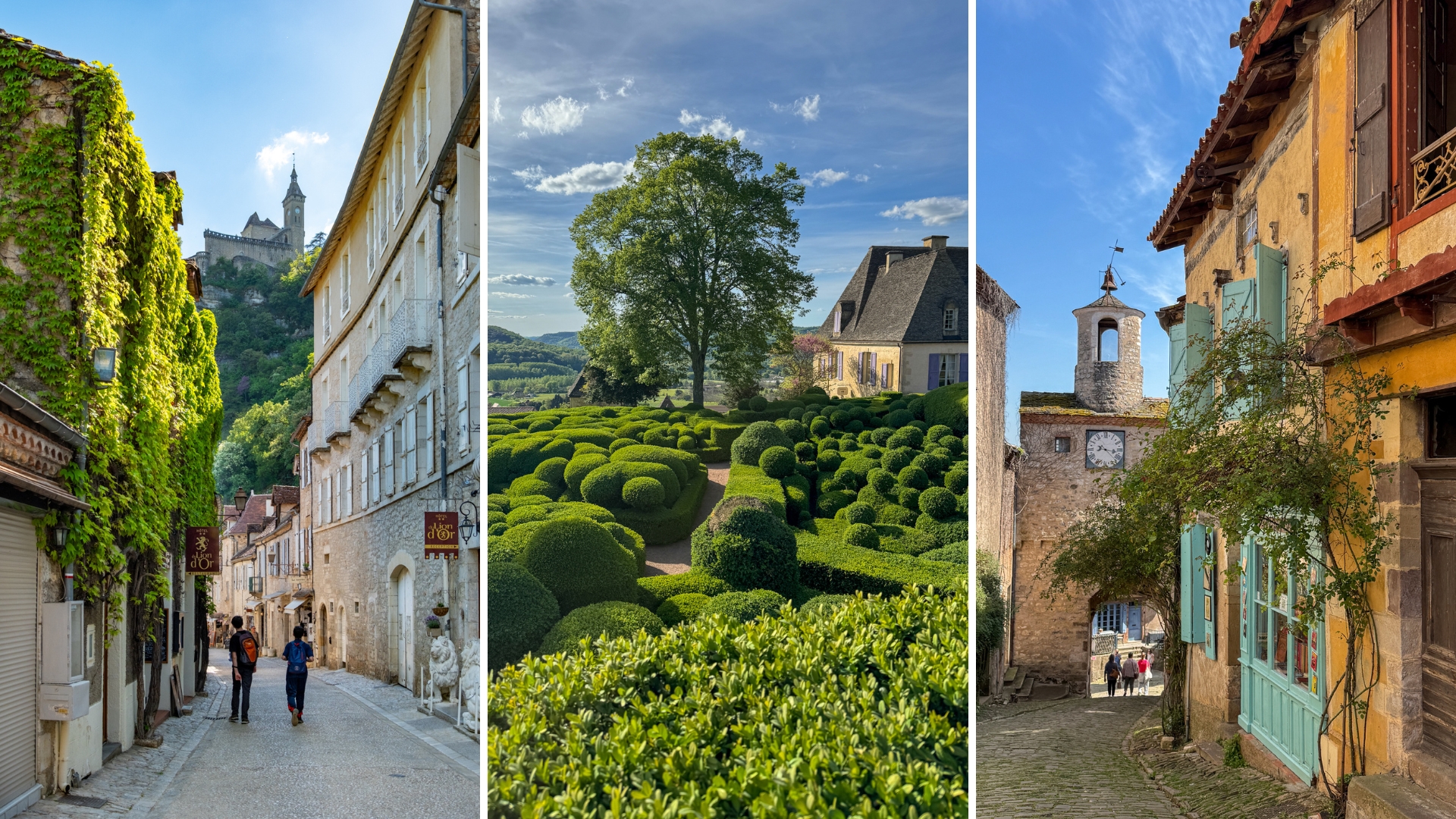
The château itself is lovely, but the real highlight here is the acres and acres of gardens. We saw one singular photo of some of the gardens' whimsically-pruned boxwoods and knew we had to visit.
Just know that the gardens are much larger than you probably think based on photos! There are kilometers of trails here, and to fully explore the gardens you'll need a couple of hours. (Also note that the gardens are atop a big hill!)
Pro tip: Wear good walking shoes, and stretch those calf muscles for this trip. Many of the towns and castles on this list are on top of hills, meaning you're going to be walking uphill quite a bit!
4. Lascaux IV cave

Chances are if you know anything about prehistoric caves, then you'll know about Lascaux. Lascaux Cave, situated in the Vézère Valley of the Dordogne department, is one of the most fascinating prehistoric sites in all of France. Named a UNESCO World Heritage Site due to its historical significance, this cave features more than 600 prehistoric paintings estimated to be between 17,000 and 22,000 years old.
The original Lascaux cave was famously discovered by some teenagers and their dog in 1940, and almost immediately opened up for tours. But, due to the cave's small size and the damage caused to the paintings by so many thousands of humans breathing on them, the original cave was closed to the public in 1963.
Luckily for those of us who didn't get to visit the original, they built full-scale replicas! The replica you want to visit is Lascaux IV. This replica is a perfect reconstruction of the cave and its detailed artwork, including incredible ancient paintings of bison, deer, and horses painted with natural mineral pigments.

You'll tour the cave with a guide (be sure to book in your preferred language) and then get to visit an immersive museum where the paintings are once again replicated — but this time in ways that you can get close to and take photos of!
5. Château de Hautefort
My fellow Ever After fans… prepare yourselves for this one!

Château de Hautefort is one of the most beautiful châteaux in the Dordogne — and it featured prominently in Ever After as the royal residence in that movie.
Unlike many of the austere, defensive medieval castles in the region, this château was reconstructed in the 17th century in a more elegant style reminiscent of what you find in the Loire Valley. In the 19th century, a gorgeous formal garden was added, which is still one of the highlights today.
The chateau's modern history is interesting, too; after falling into disrepair for decades, it was bought in the 1920s by the Baroness de Bastard and her husband. They restored the castle, lovingly cared for it, and even rebuilt it once after a fire. Their family still owns and runs the chateau.
Château de Hautefort is open for self-guided tours, and you can explore pretty much everything, from the old basement kitchens to the more modern bedrooms. The grounds and gardens are stunning, too, and there's even a small cafe on-site that serves coffee and lunch.
6. La Roque-Gageac

Let's shift from castles and caves to a cute town for a moment! La Roque-Gageac is a small village on the Dordogne River that's more or less built right into a sheer stone cliff, and it's one of the Les Plus Beaux Villages de France (“the most beautiful villages of France”).
The village is small, but is home to a defensive fortress (Fort de La Roque-Gageac) and also Château de la Malartrie (which is now a vacation rental). You can also take cruises on the Dordogne in traditional Gabares river boats here.
We stopped here for dinner (at the delicious La Belle Étoile, which is on the Michelin Guide), and even saw hot air balloons floating over the town at sunset.
7. Gouffre de Padirac cave


Moving into the Lot department of Southwest France, let's talk about another unique cave you can visit. Gouffre de Padirac is a spectacular cave that features an open-air chasm leading to an underground river winding through limestone caverns. And the best part is that you can explore a lot of it.
Visitors descend via a lift or a metal staircase into the depths of the sinkhole-like chasm, where you then enter the cave system itself. You'll follow an audioguide at your own pace and eventually board a boat to glide through the clear waters of the underground river. The boat takes you to yet another section of the cave system where you follow more paths through fantastical cave formations.
This cave requires a lot of walking (and quite a bit of stair-climbing), but it is SO COOL. Riding the boat on the underground river is just so unique!
8. Rocamadour

Just 25 minutes from the Gouffre de Padirac cave is the village of Rocamadour, one of the most beautiful destinations in the Lot department. Rocamadour looks like something straight out of a fairytale, with the picturesque medieval village literally perched on top of a stone cliff in the middle of the countryside.
Rocamador has long been an important pilgrimage site, with many pilgrims passing through as part of the Camino de Santiago. The significance of the village stems from the 12th-century Black Madonna statue in the Chapel of Notre-Dame, which has many miracles attributed to it.
Aside from visiting the church where the famous Black Madonna statue lives, you can also take in panoramic views from all around Rocamadour. As a popular tourist destination, there are also plenty of restaurants and shops to check out here.
We stayed one night in Rocamadour, and had dinner nearby at Resto bistrot l’Estanquet, where I had what I legitimately think is the best duck confit I've ever eaten.

9. Pech Merle cave
Another amazing prehistoric cave site you can visit is Pech Merle cave. Located in the Lot department, this cave was discovered in 1922 by local teenagers (what is it with teenagers crawling into random holes in the ground?). Archaeologists were stunned to discover the prehistoric paintings on the walls of the caverns.
The cave paintings here date back around 25,000 years (!!!) and depict animals like bison, horses, and even mammoths, and also feature human handprints. Unlike the Lascaux caves where visitors are only permitted to enter a replica cave, though, visitors to Pech Merle can see the original cave art because this cave system is so much bigger, and not so prone to damage.

You do need to pre-book tours here (in your preferred language), as they limit how many people can be inside the caves at once. No photos are allowed inside, but I promise it's well worth visiting to see the incredible prehistoric art up close.
10. Saint-Cirq-Lapopie
One of the most enchanting medieval villages in Southwest France is hands-down Saint-Cirq-Lapopie. This is another hilltop town in the Lot department (they really are everywhere!) with beautifully preserved stone architecture and a medieval fortress.


The streets of Saint-Cirq-Lapopie are impossibly charming, with cobblestone lanes, stone archways, and ancient cottages with vines and flowers growing up the walls. Visiting in April was extra magical with so much in bloom.
Andre Breton, one of the founders of the Surrealist art movement, famously claimed he “stopped wanting to be elsewhere” after visiting Saint-Cirq-Lapopie in the 1950s, and he remained there until his death in 1966. Today, the artistic legacy of Saint-Cirq-Lapopie can still be found in the artisan workshops and art galleries throughout the village, which remain mostly locally-owned despite the town being a popular summer tourist stop.
This is another of the Les Plus Beaux Villages de France (“the most beautiful villages of France”).
11. Cahors + Cahors wine region

Cahors is a lovely town nestled around a bend in the Lot River. Although founded in the Roman era, this town is best known for its well-preserved medieval architecture, including the striking Pont Valentré, a 14th-century bridge featuring stone towers and arches that you can still walk across.
Beyond the beauty of the town (especially in the city center), Cahors is known for its wine production. Vineyards around Cahors produce deep red wines with a rich, intense color and flavor — and this region is the historical home of the Malbec grape!

Touring local wineries is one of the best things to do on a visit to Cahors; we visited Clos Triguedina (which offers tours in English) and Mas del Périé | Fabien Jouves (tastings only in French).
The town is also a great destination for foodies, with plenty of excellent restaurants to try. Highlights of Cahors and the Lot Valley include foie gras, truffles, and walnuts, and we had a fabulous meal at Chez Suzanne.
12. Cordes-sur-Ciel

Cordes-sur-Ciel is a fortified town in the Tarn department of Southwest France, founded in the 13th century. The unique name of the hilltop town (“Cordes in the Sky”) comes from the phenomenon of clouds gathering around the valleys beneath the town, giving it the appearance of floating serenely in the sky.
This is a town that is built for wandering, with steep, narrow cobblestone streets lined with shops and restaurants. Although you'll definitely be getting a leg workout here, you’ll be rewarded with beautiful views of the surrounding countryside.
There are several ways to walk up into the town, so I recommend doing what we did: walk up one way and down another so you can discover some different fairytale views.

Cordes-sur-Ciel does get quite busy in the summer months, but we basically had it to ourselves in April. If you're visiting in the summer, though, go early in the morning to miss the worst of the crowds.
13. Albi
Located 30 minutes from Cordes-sur-Ciel is the larger town of Albi. Situated on the banks of the Tarn River, Albi is nicknamed the “Red City” because of the distinctive local red bricks that were used to construct much of the historic center. (Parts of it honestly look like they belong in Italy!)
Albi is a bigger town, but I'm including it on this list because it's not really a major tourist stop and has some really cool things to see/do.


One of the most famous places to visit here is the Sainte-Cécile Cathedral of Albi, which is the largest brick cathedral in the world. Although the outside of the cathedral is formidable, the inside is completely different, with beautiful Renaissance frescoes in blues and golds covering the ceiling.
Aside from the cathedral, another highlight in Albi is the Musée Toulouse-Lautrec. The famous Post-Impressionist artist Henri de Toulouse-Lautrec was born in Albi before moving to Paris to pursue his art career, and his hometown contains the largest collection of his work. Outside of the museum, the Berbie Palace Gardens are also worth a visit (and free!).
The town of Albi itself is also lovely to explore on foot, which is exactly what we did. Be sure to cross over the Tarn River, perhaps using the Pont Vieux, one of the oldest medieval bridges still in use in France.
14. Château de Saissac

Moving further south, the Château de Saissac is located in the Aude department of Southwest France and is an impressive ruined fortification dating back to the 10th century. This castle is notable because it was the seat of the Saissac noble family. This powerful family was part of the Cathar faith, a quasi-Christian religion (viewed as heresy by the Catholics) that thrived in the 12th and 13th centuries.
The castle was targeted during one of the Crusades, known as the Cathar Crusade, and it fell in the early 13th century. Today, the ruins of the castle are home to a museum, and visitors can enjoy the peaceful surroundings with beautiful views out over the countryside.
15. Carcassonne

Finally, Carcassonne is the jewel of the Aude department — and it's by far the most touristy spot on this list. But I'm still including it, because *most* visitors to France will never make it here.
Carcassonne is a small city that has been a defensive stronghold since the Roman era, with double-fortified walls dotted with more than 50 watch towers encircling the Château Comtal and the historic core.
This fortress once protected the historic border between France and Aragon, and was located on a strategic trade route between the Atlantic Ocean and the Mediterranean Sea. Today, the walls of the town are walkable and open to tourists, and you can also tour the 12th century Château Comtal with an audioguide.


(Just note that you'll need several hours if you want to tour the castle and walk ALL the walls!)
Another must-do here is to try Cassoulet, a typical southwestern France dish made up of beans and meat in a hearty broth. We tried some in Carcassonne at La Demeure du Cassoulet, and while the portions were huge, it was so delicious.

This of course is just a very small sampling of all the things to do in this part of France. There are more charming hilltop towns, more historic castles, and plenty more caves to explore. But this list is at least a great start if you want to get slightly off-the-beaten path in southwest France.
(And yes, I KNOW this part of France is well-known to many French people and other European tourists. But it's not well-known at all to visitors from anywhere else!)
Would you like to visit this part of France? And if so, which site would you be most excited to see?

Amanda Williams is the award-winning blogger behind A Dangerous Business Travel Blog. She has traveled to more than 60 countries on 6 continents from her home base in Ohio, specializing in experiential and thoughtful travel through the US, Europe, and rest of the world. Amanda only shares tips based on her personal experiences and places she's actually traveled!









Hi. As a Frenchman in love with my country’s south-western region , (including Bordeaux of course, where my son-in law is a Professor in the History of Art) I would like to extend my heartfelt congratulations for your well-informed, accurate and sensitive account of its natural, archaeological, historical and -last but not least- culinary delights. Well done !
Best wishes.
Christian.
Always nice to get the approval from a local! It’s a beautiful part of France.
This is exactly the kind of France trip I’d love to do. I had no idea there were so many medieval towns and caves packed into this part of the country.
The underground boat ride at Gouffre de Padirac looks incredible, and Saint-Cirq-Lapopie in April with all the wisteria might have sold me on the timing. I also appreciate the heads-up that a rental car is basically essential for this route. Definitely saving this one.
The hilltop towns and caves were definitely a huge draw for us, and they’re all so different!
What a fantastic collection of destinations! I love that this guide goes beyond Bordeaux and highlights lesser-known places with their own unique history, scenery, and charm. It’s a great reminder that some of the most memorable travel experiences come from exploring beyond the obvious hotspots. Thanks for sharing such an inspiring list!